
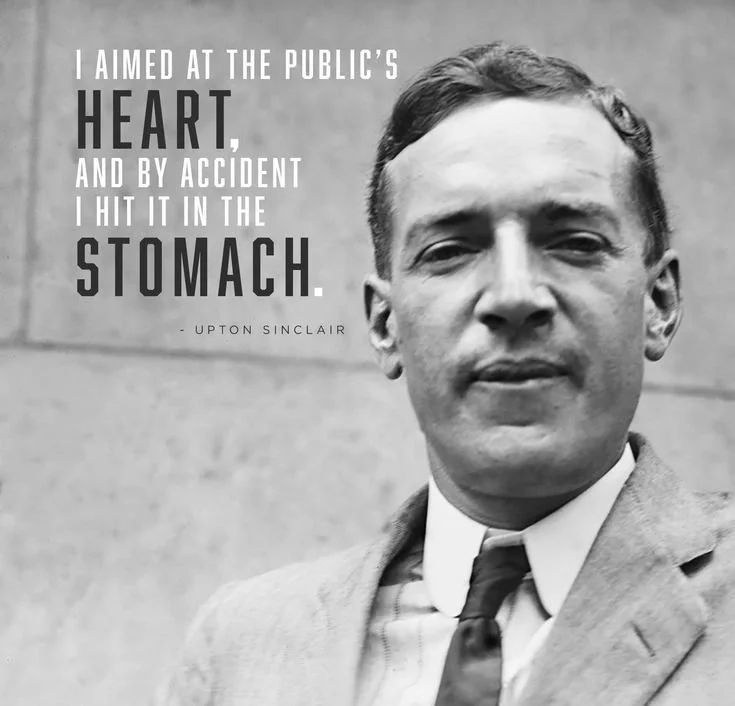
Perfect aim, Upton.
Born in 1878 in Baltimore, Upton Sinclair was a "muckraker"—a journalist dedicated to exposing corruption and society’s "muck." His book, The Jungle, revealed the filthy and brutal conditions of the late-1800s meatpacking industry. The industry owners threw every piece of every animal, diseased or healthy, into the meat they packaged and sold to the public. There was no FDA- Food and Drug Administration. Nobody inspected anything because there were no inspectors.
Sinclair’s books sold a lot of copies. People were disgusted and horrified to learn that all sorts of nasty things were included as “meat”. Everyone trusted their butcher to sell them the meat they asked for - not the butcher’s hair, bits of rat, sawdust, and whatever the cow’s owner had stuffed down the cow’s gullet to make it weigh more. (Do not think about that too much.)
Factory workers had no protection, such as goggles, aprons, hard hats, or gloves. Nobody washed their hands much, in part because nobody knew about germs or bacteria. If your hands looked ok, you were good to go. If they were a little grubby, wipe them on your aprons.
The “medicine” you got from your doctor or the old woman down the street could be anything at all:
Prior to the Pure Food and Drugs Act, medications such as Mrs. Winslow's Soothing Syrup for teething and colicky babies did not need to disclose that its product contained ingredients such as morphine and alcohol.
This is horrific.
Furthermore, the people who worked in the factories were steadily ground down by the working conditions, for the absolute minimum payment that people could exist on.
So the meat products they produced for their neighbors was poisonous. And the work they did was so grinding it eventually killed the workers themselves:
“The great packing machine ground on remorselessly, without thinking of green fields; and the men and women and children who were part of it never saw any green thing, not even a flower. Four or five miles to the east of them lay the blue waters of Lake Michigan; but for all the good it did them it might have been as far away as the Pacific Ocean. They had only Sundays, and then they were too tired to walk. They were tied to the great packing machine, and tied to it for life.”
Factory workers had no protection, such as goggles, aprons, hard hats, or gloves. Nobody washed their hands much, in part because nobody knew about germs or bacteria. If your hands looked ok, you were good to go. If they were a little grubby, wipe them on your aprons.
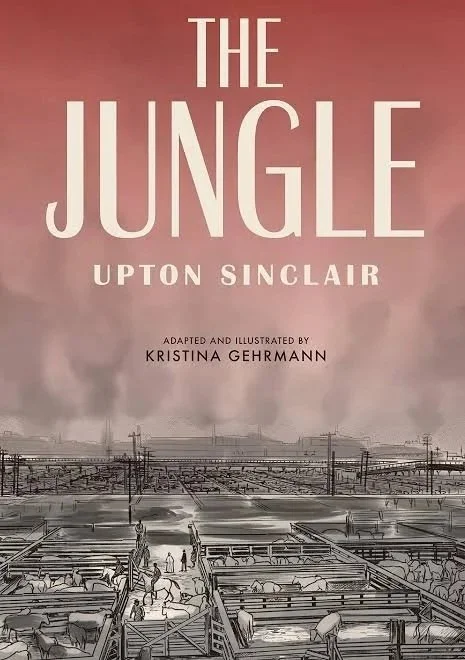
One of the many covers of Sinclair’s book
